<Back to Shining Force ASCII Guide Book
Shining Force Country Guide
Navigation:
The Continent of Rune
Let’s take a took at the continent of Rune that will be the stage for the adventure, with an overview of its topography and history.

|
Species ratio: Humans: 45% Total population: 26580 inhabitants Average temperature: 26.5°C |

An explanation of Rune’s distinct geographical aspects
As shown by the map above, the continent of Rune is shaped in quite a peculiar way, divided into an eastern and a western part by the ocean. According to ancient history research still in progress, when the previous civilization was still at its peak, the continent’s shape was very different from the current one. By Dark Dragon’s destructive power, countless peninsula were wiped out, and there’s evidence that even tectonic movement was slightly disturbed.
When it comes to topography, many are deeply interested in the differences between the west and east sides. Compared to the west side, which has plenty of flat lands, the east side is rugged and mountainous. Those geographical differences result in different developments in agriculture, this world’s main production. Also, because the west side is less rough, travel and trade between countries is easier. The eastern countries (like Runefaust), who had to dealt with tough life conditions in a harsher environment, might have naturally harbored intentions to conquer the west side, but things aren’t so simple as to just put the blame on them.

|
Past and Present Of the remaining historical records in current Rune, almost all are from less than 1000 years in the past. Records of the civilization destroyed by Dark Dragon are practically all lost, with whatever existing ones being guarded by Prompt and Manarina, who continue to decode and study them. Main events of these past 1000 years are shown in the table to the right. This Rune calendar, using the year of the previous civilization’s downfall by Dark Dragon as the starting year, is used by almost all of Rune. Plenty of countries also have their own imperial era system based on their rulers (for example, Year 999 of the Rune calendar in Guardiana is Year 28 of His Majesty Alexis’s rule), but treaties and such between countries use the Rune calendar. In these 1000 years, no big scale conflicts between countries have occurred. This isn’t due to an ideal peaceful coexistence, but because each country was busy fighting against frequent assaults by groups of magical beasts and natural disasters. As Dark Dragon’s seal is released once more in this adventure, a new age is ushered, where the real way of life of the people of Rune is put into question. |

|
|
|
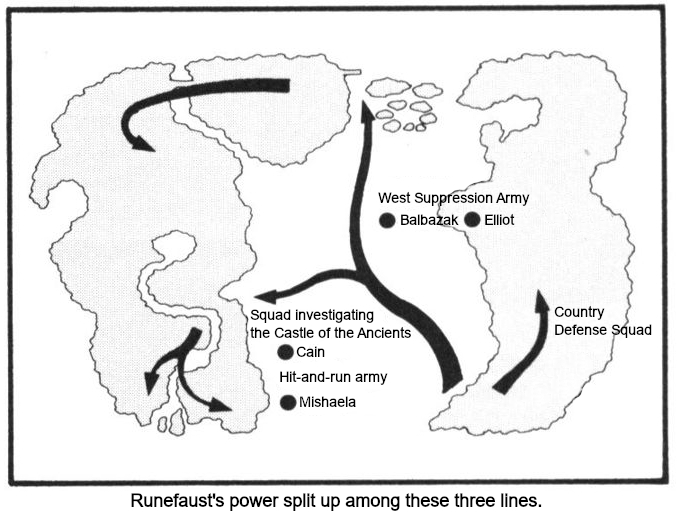
Runefaust Army - The Route to Assault Guardiana First, take a look on the map to the right, to understand the basics of Runefaust's strategy. Runefaust first dispatched its West Suppression Army. It was lead by the generals Elliot and Balbazak. As the West Suppression Army continued its setup, the Guardiana Assault Squad and the Gate Investigation Squad, led by Cain, landed in secret in the area between Rindo and Alterone. With guidance from Mishaela, leader of the Hit-and-Run Squad, they headed for Guardiana's castle. While developing their army at West Rune, they did not neglect to strengthen the line of defense around their own country as well. The perfect strategy described above was planned by their tactician, Darksol. However, the Shining Force was a factor not foreseen. Because of that, spreading out their forces ended up having the opposite effect. |
|
Kingdom of Guardiana

Population: 3000 inhabitants
GNP: 3500 gold

|

|
Species ratio: Known as the country of knights, the ratio of centaurs is high. Also, the ratio of elves is lower than that of other countries. Perhaps because they don’t prioritize mages and archers as much? |
What is the full story of the country of wandering knights?
A small country at the very south of West Rune. Around 800 years ago, with the purpose of protecting the Gate of the Ancients, a huge group of immigrants from Prompt, mostly knights, founded the country. During the rule of King Arissort Von Guardiana II, the kingdom was raided by a large group of Wyverns, and many documents were lost in the fire, thus there are no remaining records from before the country’s founding.
Their main production is agriculture. The production is concentrated in the fertile delta of the Beaune River (the source of Maar Lake at the southeast of Manarina). Starting from their specialty, the “Guardiana carrot”, they produce many diverse agricultural products, and achieved 100% self sufficiency. While still in a small scale, fishing activities have developed in the coast of the Monostone peninsula, so that region is sustained by a mix of agriculture and fishing. Since most of the country’s land is plain field, it lacks in mineral resources, and industrial development is very slow. Because of that, it currently does not have goods to export, and thus has not established trading with other countries. One can say that self-sufficient agriculture is the lifeline of Guardiana’s economy.
History wise, since it was founded by knights, it is to be expected that the citizens value the military arts. Having said that, they are not the kind to fight for no reason, and their standards of education are also relatively high. Since they’ve inherited a peculiar chivalrous spirit, their culture is permeated by the philosophy of being adept at both literary and martial arts.
The Fighting Tournament held every six months is a grand festival held through the castle and the town areas, where knights and townsfolk compete in the arts of their choice. It’s the most remarkable expression of Guardiana’s culture.

|
Following the road to the east, there’s the Gate of the Ancients and the mountain cabin. The road extending to the northeast connects to Guardiana’s only allied country, Alterone. Guardiana’s castle and town blend together into a castle town. Alterone also followed the same model. |

|
The bustling town is usually peaceful. Because of that, selling weapons isn’t a great business there, and it seems the shop owner has decided to retire. Guardiana’s only inn, the Guardiana Hotel, has been in a slump day after day. Not many tourists are coming. |
Translation notes:
- Lots of names for kings and places in this guide are not mentioned anywhere else in the series, so I had to pick the spellings myself based on the katakana. Anri's father, Alexis, is an actual name. Arissort, on the other hand, is not as far as I know, but it was the best I could think of. Beaune is the name of a french city named after Belenos, a god of flowing water, so I guess it makes sense as a name for a river. Maar is a broad, shallow volcanic crater, so it made the most sense for the lake name as well.
- The Fighting Tournament is mentioned in Hans' bio, as well as in the Saint Fencer manga. It is also mentioned by Arthur in the GBA version, because most of Arthur's HQ dialogue in that game is references to this guide, actually. I'm very grateful as that means I have help in understanding these names.
- Arthur mentions the specialty carrots as well in the GBA version.
Kingdom of Alterone

Population: 5000 inhabitants
GNP: 27000 gold
|
|

|
Species ratio: Since it’s a country founded on mining, there are many of the physically strong dwarves. Also, there’s notably not many centaurs. From this data, one might wonder if Alterone’s army is lacking. |
No cure for being spoiled rotten by money
A newly prosperous country in the mountains at the center of West Rune. Around 200 years ago, a town was built to extract ore from the northeastern mines, and as the population sharply grew in a short span of time, government became chaotic, and it failed to become a stable city-state. After that, Guardiana mediated things and assigned a administrator to it, and staying 99 years under this concession, its political situation came under control. Its independence was recognized 100 years ago, and it became a constitutional monarchy headed by the administrator from Guardiana.
Their main activity is steelworks, using their abundant mineral resources, and their production of processed goods such as weapons and armor increases year after year. Also, a mineral of extraordinary hardness (maybe Mithril?) was found in the mine opened to celebrate the centenary of the country’s founding, and exportation has gone up by a remarkable 180 percent. In a single year it became a focus of commerce. The industrial policies enforced by the current King Charles Granard Culprang Don IV, known as the “Miracle of Alterone”, restored the economy.
The citizens are gentle and heavily inclined towards pacifism. Because of the barren and mountainous terrain, they used to lead a frugal lifestyle, but the sudden rise in life standards led to eccentric changes in their culture (ostentation of the nouveau riche). As an example of this, they’ve bought every work of art they could get their hands on from Rindo and such places, getting also the antipathy of several countries with that. On the other hand, neighboring countries like Guardiana couldn’t renew their own economy without keeping connections with Alterone, and thus more complicated international problems formed.

|
The castle town surrounded by forest. A road was built to facilitate the delivery of goods between them and Guardiana. Plenty of times you can see carriages doing five round trips in a single day. Guardiana’s economic growth depends on Alterone. |

|
The royal family and the townspeople went from rags to riches all of a sudden. Because that, they are not wise on how to spend the money. They are obsessively indulging themselves with acts such as buying artworks of dubious origins from Rindo merchants. You can’t call that real appreciation. |
Translation notes:
- The pie chart definitely doesn’t indicate many dwarves as the text does, so they have likely been swapped with hobbits. As usual. Will happen in other sections as well, I'd say always take the text over the graph, as the text has actual reasoning behind it.
- Romanization of the king’s name taken from the GBA version (thanks Arthur <3). It sounds a little different in japanese but I couldn’t find any meaning to it so I don’t think it matters.
Rindo

Population: 3000 inhabitants
GNP: 6250 gold
|
|

|
Species ratio: The place with the biggest human population in the Rune continent. The population count here only includes the residents, if you counted the travelers staying there as well, it would go up to 6000 people. Since it doesn’t have an army, the amount of centaurs is even lower than that of Alterone. |
The leading power of a liberal economy is a country based on commerce
A trading country that has just passed the 200 years mark, located at the easternmost point of West Rune, surrounded by mountains from three directions and facing the ocean in the remaining one. It was founded mainly by immigrants from fishing villages in the Guardiana southeast. They named the land they first landed on through their sea route “Costa de Alexis”, after the royal family of Guardiana. At first, it was mainly a fishing country, but eventually progressed in the arts of shipbuilding and sailing, as a coastal nation tends to. Currently they’re active on both sides on the continent facilitating commerce, and their trade with inland areas supports the economy.
When it comes to politics, they have a parliamentary democratic system, but the true power is in the hands of the merchant guild, as many of the voters are affiliated with it. The current leader, Mr. Mocha Doccha, has been elected for the tenth time (each term lasts three years) and has a huge approval rate. His mercantile policies were highly recognized for turning a developing country into a model of economic growth, but on the other hand, there are those on East Rune who mockingly call him “the west’s wallet”.
As a country built by immigrants, it has a more liberal ideology, and as the gateway to the western continent, it sees a big mix of different cultures. Its educational standards are also high, and wealthy merchants show more of their influence by having the education of scientists and artists under their guard. The laboratory of Dr. Crock, renowned as the greatest scientist of the century, was also built with the support of Zacha Doccha (the leader’s son-in-law). A project to expand on tourism was recently announced as well, with the intent of increasing domestic demand. An overhaul of the urban area, also related to stimulating the economy, was approved by a majority of the parliament. The first step planned for it is the construction of a theme park. As it hasn’t been announced yet, details are still unknown.

|
Rindo is the heart of commerce in West Rune. It often trades with Guardiana and Alterone. From its harbor, it is establishing trade routes with continents other than Rune. It is a merchant country willing to brave the empty ocean. |

|
It specializes in importing rare items from other continents. The townspeople have the Rindo theater (playhouse) as entertainment all year. And once per year, the visiting circus becomes the greatest attraction. However, due to several issues, it did not come this year. |

|
Dr.Crock’s strange experiment? The self-proclaimed genius, Dr. Crock. He is currently developing a iron armor, the “Steam Suit”, with help of his assistant, Guntz. By the way, his experiments have been failing a lot. “It’s because that darn mayor won’t fund our work!”, says the doctor. “Man, when will we ever finish this Steam Suit...” laments Guntz. |
Translation notes:
- Romanization of Rindo’s leader taken from the GBA version (thanks Arthur x2), though the son-in-law is my own take, as I don’t believe he’s mentioned anywhere.
- Mocha Doccha’s title is something like chairman of president of a council. Since these countries are implied to be little city-states and I don’t care much, I’ve been sticking with “mayor” as the english versions do, but there’s mentions of a parliament here so I switched to a vague “leader” here. Listen I don’t know political terms okay, it’s already wack enough to be constantly googling systems of government because of freaking, 90’s rpg book.
- Costa de Alexis = Alexis’ Coast in portuguese and maybe also spanish but don’t quote me on the later. Alexis has already been mentioned as the name of Anri’s dad, but this is 200 years in the past so there was probably another king with that name.
- The segment about Dr. Crock and Guntz is taken from the Event Checkpoint section of the guide, which I've mostly omitted just to being just playthrough guidance, but this one had some interesting character bits so it's here.
Manarina

Population: 200 inhabitants
GNP: Unknown
|
|

|
Species ratio: Since it’s the country of magic, the ratio of elves is relatively high, while that of species with low magic talent such as centaurs and dwarves is low. The 19% percent in the “others” category is mostly monsters of unknown species. |
Spiritual ideals as the basis of collectivism
The western coast of West Rune has the typical coastal climate, with a rain precipitation of over 2000 millimeters and warm temperatures, that give place to lush forests. The spiritual country of Manarina expands from these forest region to the mountains.
It is recorded in the ancient “Book of Genesis” that, around 3000 years ago, the first generation’s Otrant (the current Otrant is of the 34th generation, full name Otrant Eismann, also knows as the “Thousand Eyes Guardian”) retreated to this land to train magic, and that’s how the country came to be. After that, mages came from many other lands idolizing the powers of the successive Otrants, and formed a commune of sorts. It was a primitive collectivist community with loose social and spiritual ranks based on one’s magical power. Even nowadays its structure as a country remains lax, with only Otrant’s authority as a constant. Citizens only have to pay taxes to fund public works, and don’t have any political duties.
They entrust their economic activities to Rindo’s merchant guild, and also follow the same currency as Rindo. Many citizens make their living out of magical materials and magic-infused goods.
In this Manarina of harsh spiritual discipline, frugality is seen as a virtue. As most people follow an ideology of stoicism, there isn’t much entertainment. Only those on top of this magical world are respected by people of the other countries, and in Shade, a state of similar religious inclination, the people of Manarina are respectfully known as “people of the holy scriptures”.

|
Manarina is a single mansion being built upon over and over. If you want to go live in Manarina, first you must build your own room. It’s common for rooms to be taken over if the owner left for too long. |

|
There’s no entertainment in Manarina. That isn’t because everyone is training hard. Since they work on plenty of weird studies, there’s not a moment of boredom. They sure use up all their funding, but that might not be so great after all. There really seems to be a bunch of weird people there. |
Translation notes:
- Otrant's full name romanization taken from the GBA version (thanks Arthur x3). The wizard's title however is my own take. The GBA version goes with "All-Seeing Guardian", which is an okay adaptation, but since Otrant has more eyes than the average person, I thought the more literal translation of "thousand eyes" still made sense and sounded cool.
- The geographical description here is likely outdated. In-game, Manarina is surrounded by desert. It was, however, depicted near a big forest in an older beta map.
Shade

Population: 20 inhabitants
GNP: Unknown
|
|

|
Species ratio: Shade is more of a village than a country. It consists of only a church and associated buildings. So its population is only 20 people. Besides the humans who work at the church, the other species there are elves. They work as guides in the mountain paths. |
The decline of royalty casts a shadow in the holy land?
A small region at the Sarastone peninsula northeast of Rindo. Back when Guardiana was founded, the Order of the Knights would be frequently sent in expeditions to expand their territory, and this peninsula was the northernmost point they reached, thus Shade became a holy land directly under the royal family’s control. After the wyvern raid from the time of Arissort von Guardiana II’s rule, a church was built in this region to appease the souls of the knights fallen in that battle, and the third prince at the time entered priesthood and became its priest. After that it became a place which disseminated Guardiana’s ways to all of the western continent, and little by little a town grew around it, thus around 500 years ago it was recognized as a holy city with the priest as sovereign, under the protection of Guardiana’s royal family.
Shade’s population, including the priest, is a mere twenty people. They are all clergyman who work on proselytizing and studying ancient texts. When it comes to politics, the executive power is Guardiana’s, while the judiciary and legislative powers are under the priest’s authority. It is generally a neutral state, but takes measures to protect the church against oppressive forces.
Throughout history, the priests have gathered previously lost records about the Castle of the Ancients, decoded ancient texts from all over the continent, thus getting closer to the truth on the Ancients and their civilization with their research. The current priest, Kahn, is in the middle of editing a compilation of this research of the past, named “Prehistory of Rune”, and it has gathered attention all across Rune, as it might shine a light on the mysteries surrounding the Castle of the Ancients. Unfortunately he’s already very old, and many lament that there’s aren’t enough people to continue his research.

|
The church is the highlight of Shade, but behind it is a small village, with some cabins offering guidance to travelers in exchange for payment. People heading to Bustoke should pay for the guides here, or they’ll get lost in their way. |

|
Shade’s bell rings once in the morning and once in the evening. The morning time is at 6am, and the evening at 6pm. This bell announcing the start and end of the days is of course heard from Rindo, but some claim to hear it all the way back in Alterone some days. |

|
Priest Kern versus Darksol Darksol disguises himself as the priest, and appear to the protagonist for the first time. Why did he kill the real priest? The current priest, Kahn, knew a man named Darksol was planning to revive Dark Dragon. He intended to tell Guardiana along with all the information the priests had gathered through the ages, but Darksol became aware of this as well. Around the time the protagonist got the Orb of Light in the Cave of Darkness, Darksol arrived at the church of Shade, and attacked the priest. Kern might have lost, but inflicted deep wounds on Darksol. That’s why he fled from the protagonist that time. |
Translation notes:
- Romanization of the priest’s name is my own, Arthur was unhelpful for this one.
- The section about the priest and Darksol's battle is just a quick recap of the game's plot, though these details were removed by the localization as usual. This section is actually just to fill page space, as other areas fill the same space with data on the items and weapons available, but Shade Abbey has no shops.
Bustoke

Population: 800 inhabitants
GNP: 2900 gold
|
|

|
Species ratio: The territory isn’t big, yet the population is bigger than you would imagine. As for the species distribution, since the terrain is all forest, there’s a lot of elves. Among the 18% percent of humans, many have mixed blood. |
A critical point of modernization arrives to the people in the heights
A diverse country at the north of West Rune. Hunters settled mostly in the forest region among the mountains. As the territory was split between many different tribes, small scale conflicts happened time and time again. In the past, many magical beasts lived in the area, making it an extremely dangerous place, but around 500 years ago, a wolfling hero knows as the Young Wolf King (Zylo’s ancestor) suppressed the beasts, and founded the country, unifying the tribes.
As the country has many different races, is crucial to have a strong leadership, and the current king Zylo Dunn Munster (meaning “Zylo, king of the mountains” in the region’s dialect) rules fiercely, despite allowing his people many freedoms.
Self-suficient hunting is their main economic activity, so there’s not much trading, but the marble and obsidian extracted from the southwest are highly valued as construction materials. However their mining skills are low and haven’t been very efficient with these extractions, and thus there’s a joint venture with the merchant guild of Rindo to develop modern excavation tools. Also, Bustoke strawberries, which were once eaten even by the magical beasts, and are said to taste great in juice, had their numbers dropped drastically due to overconsumption, and nowadays can only be harvested by the royal family, the exportation to other countries being forbidden as well.
The most distinct point of their livelihood is definitely the unique habitations built in the mountain walls. The natives’ faith worship the forest, thus it is forbidden to cut tree for lumber, and on top of that there’s little plain terrain, so this kind of dwelling naturally came to be. Since they are on great heights, the temperatures are low. Their designs work well for keeping them cool during the summer and warm through the winter, but in other countries some will still badmouth them as “hole people” or “primitives”.

|
Bustoke is built among the towering cliffs. It is surrounded by forest and quarries, but that environment doesn’t seem to bother them at all. From the tallest point of the country, seeing the Pao bridge is a given, but on clear days with no clouds one can see all the way to the Pao plains. |

|
The famous bungee jumping of Bustoke. When coming of age, one must jump off a precipice held by nothing but a single rope. Is it a ritual done since long ago for boys born in Bustoke. In recent years, tourists have come to enjoy it as well. |
Translation notes:
- Zylo’s full name romanization is from the GBA version.
- Given how many young heroes there are in the series, I figured the title for Zylo’s ancestor is young wolf hero. However! 青 can also mean blue/green, so technically there’s nothing stopping you from picturing a technicolor furry family for Zylo. Do what you will with this information.
Pao

Population: 130 inhabitants
GNP: 2300 gold
|
|

|
Species ratio: The Pao tribe itself has only 130 people, but as they often take visitors on the ride as well, the population tends to fluctuate. Most are humans, as Pao citizens are racially homogeneous. |
The transport revolution attained by the people of the plains
The Pao plains are around 1500 meters above sea level. This vast area that makes up the majority of the northern region of West Rune is entirely territory of the nomadic people of Pao. Around 2500 years ago, there was a massive immigration from East Rune, going from island to island of the Uranbatol archipelago. This group arrived all the way to these great plains after many generations, and their population slowly increased as well. It eventually divided into several tribes (still sharing the same ethnic identity) that would gather than split up again and again through their nomadic lifestyle, until an influential tribe emerged in the southeast around 2000 years ago, and got the others under their control (with an hereditary line of succession).
Paopigs were wild creatures living in the region, but being naturally calm animals, they were incredibly well suited for the nomads. The people live off mostly raising the paopigs as livestock, making dairy products out of their milk, and other specialties such as woolen goods made from paopig hair. These woolen goods in particular are valuable enough to gather merchants from other countries all year around, fighting for the chance to buy them. They mostly use the bartering system, with little interest to adopt any foreign currency.
It can be said that the adventurous and pioneer spirit of the Pao people is what made it possible to establish a nation in this region. As they continued to live reliant on the paopigs, they developed a strong faith on them as holy beasts, and thus do not eat their meat. Around 150 years ago they found by chance a huge engine in ruins of the previous civilization, and built the Pao Train. It brought a huge upheaval in their economy when it comes to the circulation of goods, and their culture has been modernizing as well. Besides that, the Pao Train also brought an energy revolution, as they began successfully using paopig excrement as fuel for it. Currently, Pao welcome a time of great changes.

|
At a glance, it looks like a mere village. However, this is how Pao looks like while the Pao Train is stopped. A kilogram of paopig excrement fuels the train to run approximately 20 kilometers. The Pao Train is 300 meters long. |

|
The paopig’s cry is surprisingly beautiful. It is comparable to the sound of a sitar (an octave higher to be precise). Such heartrending echoes deeply move the hearts of travelers around. |
Translation notes:
- My translation of the last caption is a bit shaky. It mentions an instrument called カラッコ (karakko), and I could not find translation anywhere, so it might be made up? But since I was unsure I just brought up the sitar it is compared to right after.
Waral

Population: 300 inhabitants
GNP: 5600 gold
|
|

|
Species ratio: Waral is built atop a small island. The 50% percent of “other” species here are all merpeople. While they do not show up in the game, plenty of merman live there as well. |
The ocean people who lost themselves in the mermaid paradise
A small island country north of the Lunatic Ocean. It has the hot and humid climate of tropical rainforests, and the coast is rich in resources. At the southern coast of the island, there is an encounter of warm currents flowing north and cold currents flowing south, called “The Sea God’s Cauldron”, famous for the frequent shipwrecks it causes. Around 150 years ago, a fishing ship from Rindo suffered such an accident and drifted to Waral, founding the country. Back then, Rindo was still a fishing country, and their main fishing spot was the “Mermaid’s Roundtable”, a wide shallow beach west of Waral.
The stranded people thus settled in the island, and eventually the fishing spot to the west became theirs alone, as Rindo shifted to merchant activities. Even now fishing is their main activity, with 70 percent of the population working on it, and the remaining part being mostly shipbuilders and the merpeople who already lived in the region.
Back when the country was founded, coexisting with the merpeople was a huge social issue for the small island. However, Harengett Splasher II of the royal family married a mermaid, reaching a compromise between both parties this way, and it stays to this day. Some historians criticize this as a marriage of convenience.
The country was born out of an unfortunate accident, yet supported by the warm climate and its plentiful resources, the citizens are distinct for their endless cheerfulness. Its GNP of 5600 gold is third place in Rune, after Rindo. In recent years it has also been planning to expand its tourism business, as its strategic positioning right between the west and east parts of the continent makes it a country that cannot be ignored.

|
It’s an unusually small island, yet it is blessed with warm climate and plentiful resources. Because of this, it might be the greatest place to live in all of Rune. Its main activity is fishing, but just setting up nets is enough to catch plenty of fish, so people don’t work much. |

|
Described by the king himself as a tropical paradise, life in Waral is full of pleasures. Swimming in the ocean, fishing, gathering shellfish and the like in the beach, there are plenty of ways to kill time. Even so, some who are still bored have began to venture into the tourism business as a hobby. |
Translation notes:
- The weird royal guy name was unfortunately left for me to romanize. I have no clue if his first name means anything. His last name, チャップチャップ, is literally “chopchop”, but given that it is close to チャップン, the onomatopoeia for splashing, I feel that’s the joke they were going for.
Rudo

Population: 40 inhabitants
GNP: 1700 gold
|
|

|
Species ratio: Much like Manarina, Rudo doesn’t look anything like a country. As said in game, it is in fact just a village. The species distribution is very balanced, excluding centaurs. Perhaps they have all gathered together because of the dragon gods. |
The mountain village of the dragon gods’ faith, declining in population
The west side of the Dragonia mountain mass is extremely steep, and this natural barrier forms an unusually long and narrow coastline between mountains and the Cypro Sea. The village of Rudo is in this northwestern area of East Rune.
Around 300 years ago, to protect the Sacred Dragons who were on the verge of extinction, the royals of Guardiana proposed that each country sent some settlers there, and thus the village was born. At first they succeeded in their conservation efforts, but then reached a dead end, and in recent years there has been a sharp increase in the number of people leaving the village and spreading the view that the Sacred Dragons are over.
To show how complicated this tendency has become, the village currently only has about 40 people. It is also said that they are all children under the age of 11. The adults seem to have moved to some other village north of Prompt. The Sacred Dragon faith the adults had converted into was still deeply rooted in the hearts of the children, and some sociologists think of this village’s separation as a sort of religious schism. The children, following a girl named Karin as their leader, have developed small scale agriculture and fishing, restoring the self-sufficient activities the village had sustained so far. Besides that, they have also gone past their original boundaries, advancing halfway up the Dragonia mountains and hunting there.
Before the schism, the village had a prosperous fishing industry in the calm waters of the Cypro Sea, as the gulf surrounded by sandbanks on its north and south made for a good fishing spot thanks to the ocean currents. Some think the place could recover economically fairly easily if the population problem was solved.

|
Rudo village is blessed with a surrounding environment of plains and the ocean. It is hard to believe that the place is suffering from a decline in population. Going east from there, there’s Dragonia, where the remaining Sacred Dragons live. |

|
Since there are so many children younger than 10 gathered together, the village is really lively. They aren’t playing around, being pretty busy each with their own tasks (such as taking turns to cook or doing the laundry). Despite that, the whole village has the feel of being their playground. |

|
The destined duo, Cain and the protagonist, and Darksol’s scheme Cain has been the great archenemy to the protagonist through the first half of the game, and finally the Shining Force fights the decisive battle against him in Dragonia. When Cain is defeated, his real face behind the mask is revealed… The truth is, Cain and the protagonist were both swordsmen sent to this world with the same mission. They were meant to join forces in fighting Darksol... |
Translation notes:
- The last part is from the event checkpoint part of the guide, and I included it here because the wording is interesting. “Sent to this world” is some weird phrasing that is only used here from what i’ve seen, and reminds me a lot of their different backstory in the GBA version. Everywhere else they’re just treated as descendants of a family meant to tend to Dark Dragon’s seal, which is vague enough for either interpretation. So perhaps some idea of them being from the past was already kicking in the writer’s head.
Prompt

Population: 1000 inhabitants
GNP: Unknown
|
|

|
Species ratio: Prompt is the country of direct descendants of the Ancients. Therefore the population is mostly human. The other species are impossible to identify, as there’s no data on them. They are said to carry the blood of the previous civilization in their veins. |
The cradle of civilization that passes on the blood of heroes
A large country in the center-south of East Rune, in the so-called Old World. It is said to have been founded around 1000 years. The founders were the few survivors of the fall of the previous civilization, but the objective of this founding according to the Book of Genesis was “the succession line of the heroes entrusted with a duty to Dark Dragon’s seal”. It is unknown if this is true fact or not. Historians are stuck in a dead end on this research.
It is currently an extinct volcano, but Mt. Siglas has previously caused many disasters in this land. The reason Prompt’s castle also got buried underground when close to its completion was also due to a huge earthquake. Going on a bit of tangent here, the Conga Basin was also formed due to a caldera from an eruption of around 7000 years ago.
Metapha, floating at the southwestern coast, has been a prosperous place of religious cultural exchange, however due to Darksol’s looming threat in recent years, relations with other countries have been forbidden. Many ancient writings relating to the previous civilization have survived in Metapha. Prompt historians are the ones most infuriated at the series of incidents with Darksol.
As the Ancients were a civilization of advanced scientific knowledge, their descendants are incredibly cultured as well, but live frugal lives in order to hide it. Once a theory became established that the fall of the previous civilization was due to their scientific advancements going rogue, this tendency became stronger, and their lifestyle has fallen to what could be called primitive. The sumptuary laws proclaimed by the current king, Grando Zussa XII, are likely another reason for this.
Their main activities are farming and hunting. Of course, because the land is bad, harvest isn’t plentiful. Not much of their food comes from the agriculture.

|
The country is within the jungle, and not even Runefaust can pinpoint its exact location. Had Darksol been able to find it, Prompt wouldn’t be able to exist as it is. He is perhaps more trouble than any volcano... |

|
The people of Prompt are said to keep a stylish appearance. The way you see them in town (with unshaved faces and naked chests) is somehow disguising their suits! ...or that’s the rumor that goes around. No one has confirmed its authenticity. But, it’s tough to picture a stylish image from that. Sorry. |
Translation notes:
- Mt. Siglas romanization taken from the GBA version, not thanks to Arthur this time, but Torasu's HQ dialogue mentions it.
- The king's name is my own translation, however this name is already an oversight to begin with. He's named Kusuko/Kusko in-game. Perhaps the writer forgot.
- A basin, geography wise, is a dip or depression in the earth’s surface. A caldera is a hollow formed by a magma chamber emptying after an eruption. I learned more geography through this guide than through all of high school.
- In the GBA version, the non-human species of the world are explicitly said to have been created by the Ancients. This is never fully stated in the classic game, but the mention here of why Prompt is mostly humans seems to agree with that. Runefaust's entry next will contradict that to an extent, though. And even in this entry alone, there's space for debate, as it does mention unidentified species carrying the blood of the Ancients.
Runefaust

Population: 2000 inhabitants
GNP: 3450 gold
|
|

|
Species ratio: The huge amount of centaurs is because, much like Guardiana, the country was created mostly by knights from the previous civilization. The population used to be 2000 inhabitants but, since Darksol arrived the army has expanded. 8000 have joined in for military affairs. |
The rampaging nation causing international distress
The country was founded around 800 years ago, to watch over the Gate of the Ancients to the south of East Rune, just like Guardiana. The founders were mainly knights from Prompt but, this region used to have many small countries and barbarians (people whose cultures had been completely ravaged by Dark Dragon), so establishing the country was extremely rough. After called their homeland for reinforcements countless times, they finally managed to take control of the many countries in the area.
Their political system is a constitutional monarchy, but the knights are extremely influential, and thus the royals’ authority weakened little by little. The current king as well, Arc Rei Ramladu VI, just lends his approval to the authoritarianism of his chancellor Darksol. In recent years the army has expanded at a remarkable rate, conquering one after another the small countries surrounding it and taking over their land. Its territory is already three times larger than it was during the previous king’s rule, and it quickly became a huge military power.
On the other hand, the agricultural economy it sustained before has collapsed, and it diverged extremely from Guardiana, though they once held the same goals. All that sustains its economy now is the exploitation of conquered lands, and the tyranny of Runefaust’s army as it continues to raid country after country now shows even to the west part of the continent, beyond the Lunatic Ocean.
It once had the respect of other countries as a leading power of chivalrous spirit that valued the military arts, but as mercenaries continued to come in, it became a crude belligerent nation. It seems that the knights of the past were executed. There’s nothing within the country itself that can curb its military expansionism now.

|
Until not long ago there were many small neighboring countries. However, they were all destroyed and annexed into Runefaust. The menacing power of a military empire can be felt from the great wall surrounding it. One can’t help but be impressed as well. |

|
In the peaceful time before Darksol arrived, the greatest entertainment were fighting tournaments from the knights, much like in its sister country, Guardiana. Since the country was more stoic than Guardiana, there were no other forms of entertainment to note. |
Translation notes:
- As I mentioned in the Prompt section, despite that section implying the Ancients were human, here it is said that the knights in that civilization were already centaurs. That doesn't disprove the idea that the species might have been created by humans, but it shows that they were around long enough to be integrated into their society (at least in certain roles).
The stage for the final battle,
the Castle of the Ancients

this is what it is
A castle of devils, or a holy land?
The place where Dark Dragon is sealed. It was originally a facility for extracting resources from the seafloor, made by the Ancients. Being a giant building with over 10 kilometers in diameter, it took 20 years for it to be completed even with the Ancients’ scientific prowess. Created with the assumption that it would be staying underwater for long periods of time, it was designed to withstand over 1000atm of pressure, and its exterior is made of a special alloy with a ceramic coating.
As the Ancients saw their civilization fall, their repurposed this facility into becoming Dark Dragon’s seal, adding the defense system led by Colossus, and then sinking it to the ocean’s depths. After that, they wrote a manual for the control of the facility into a single flat metal piece called “the Manual of Secrets”. This is final stage of “Shining Force”.

|
The Gate of the Ancients. There was one to the west of the Guardiana Kingdom as well, but the one pictured here is the one west of Runefaust. Within them lies a mechanism leading to the castle. |

|
The place you arrive at upon warping from the Gate. Lots of machines can be seen in use. It shows the power of the ancient civilization. |

|
The interior of the castle has a plain design. But castles bring to mind the idea of defending from foreign intruders, and it does resemble the usual buildings in that sense. Within its depths will be the final battle... |
